Mesh Fabric for Sportswear: B2B Sourcing Guide to Types & CFM Ratings
Direct Answer
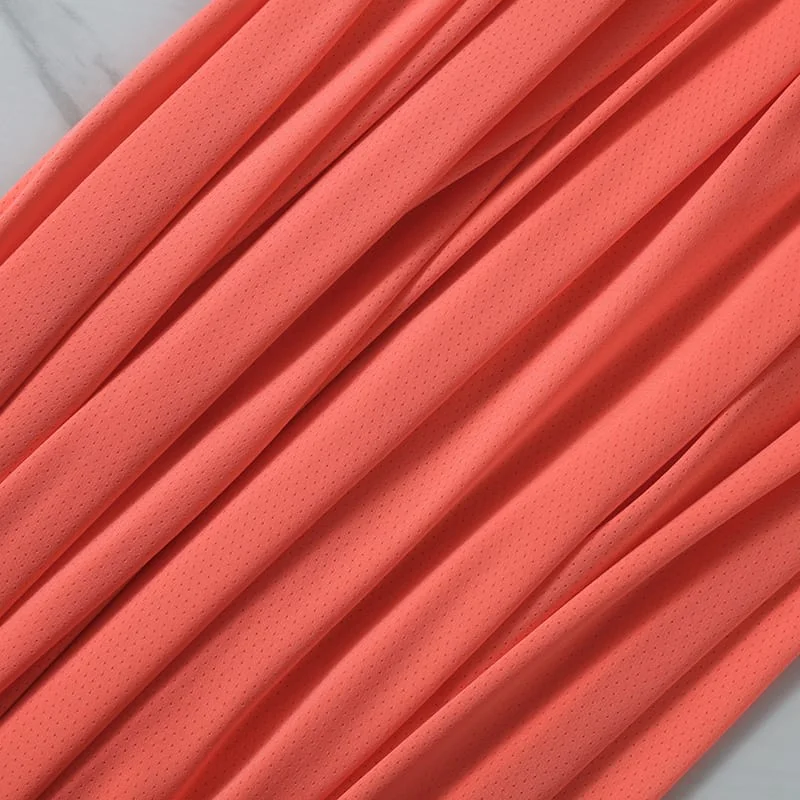
Mesh fabric is a knitted textile with an open, net-like structure featuring evenly spaced holes that allow air and moisture to pass through freely. Mesh delivers 3-10x higher breathability than solid fabrics (80-200+ CFM vs. 20-40 CFM for jersey), dries 50-70% faster, and can reduce skin temperature by 2-4°F during exercise.
For B2B sourcing, the three critical specifications are:
- CFM rating (air permeability) — Match to activity intensity: 80-120 CFM for light activity, 120-180 CFM for training, 150-200+ CFM for high-intensity sports
- Opacity — Lighter colors and larger holes require opacity testing; bird's eye mesh offers better coverage than eyelet
- Stretch recovery — Spandex content (5-8%) enables 4-way stretch; demand >90% recovery after 50 cycles
The main mesh types for sportswear are: eyelet mesh (large holes, maximum ventilation, jerseys), bird's eye mesh (small diamond pattern, durability + breathability balance), and matte mesh (non-reflective, premium appearance).
TL;DR — Key Sourcing Takeaways
- Breathability benchmark: Mesh fabric ranges from 80 CFM (fine mesh) to 200+ CFM (open eyelet)—always request lab test data, not marketing claims
- Opacity trade-off: High breathability often means low opacity—test white/light colors in fitted garments before bulk production
- Construction matters: Warp-knit mesh is more dimensionally stable than weft-knit; specify construction method in RFQs
- Stretch requires quality spandex: Cheap spandex mesh stretches but doesn't recover—require ASTM D3107 recovery testing
- Finish affects performance: Matte treatments improve aesthetics; moisture-wicking finishes improve function; both are optional upcharges
Table of Contents
- Why Mesh Fabric Matters for Sportswear
- The 7-Step Mesh Fabric Selection Process
- Mesh Specification Comparison Checklist
- Questions to Ask Your Mesh Fabric Supplier
- Common Mesh Sourcing Mistakes
- Related Resources
- About Huada Creation's Mesh Capabilities
Why Mesh Fabric Matters for Sportswear
Mesh fabric isn't optional for serious athletic wear—it's a performance requirement. Here's why:
The overheating problem: During high-intensity exercise, the body generates 500-1500 watts of heat. Solid fabrics trap this heat against the skin, raising core temperature and degrading athletic performance by 10-20%.
How mesh solves it: The open-hole construction creates direct ventilation channels. Air flows through the fabric (not just around it), enabling convective cooling. CFM ratings of 150+ mean air moves freely enough to provide tangible temperature reduction.
When mesh is non-negotiable:
- Running and HIIT apparel (back panels, underarm vents)
- Basketball and soccer jerseys (full-body mesh construction)
- Cycling jerseys (strategic ventilation zones)
- Gym and training wear (high-sweat intensity)
- Outdoor sports in hot climates
When solid fabrics work: Low-intensity activities (yoga, walking), cold-weather sports, compression garments where coverage matters more than ventilation.
The 7-Step Mesh Fabric Selection Process
Use this framework when specifying mesh for new sportswear products:
Step 1: Define Activity Intensity
High-intensity (running, HIIT, basketball): Require 130-170gsm mesh with CFM 150+ Medium-intensity (training, golf, tennis): Use 120-150gsm with CFM 100-150 Low-intensity (casual, athleisure): Fine mesh at 100-130gsm, CFM 80-120 acceptable
Step 2: Choose Mesh Type by Application
| Application | Recommended Mesh Type | Why |
|---|---|---|
| Team jerseys, pinnies | Eyelet mesh (large holes) | Maximum ventilation, loose fit hides opacity issues |
| Performance polos | Bird's eye mesh | Structured appearance, good opacity, durable |
| Premium activewear | Matte mesh | Non-reflective finish, sophisticated look |
| Sports bras, fitted tops | Eyelet with spandex | Stretch + ventilation, may need lining |
| Ventilation panels | Any type | Match to main fabric weight and stretch |
Step 3: Evaluate Stretch Requirements
Fitted garments: Require minimum 5% spandex for 4-way stretch with 40-60% elongation Semi-fitted: 100% polyester with natural 15-25% stretch often sufficient Loose-fit jerseys: Stretch not critical; prioritize breathability and durability
Step 4: Test Opacity
Critical for:
- White and light colors
- Fitted/form-fitting styles
- Women's apparel Solution: Request opacity test samples before bulk; specify lining requirements if needed
Step 5: Select Weight Class
| Weight | GSM Range | Best For |
|---|---|---|
| Ultra-light | 80-120gsm | Racing, ultra-marathon, minimal coverage |
| Lightweight | 120-150gsm | Running tops, jerseys, high-breathability needs |
| Medium | 150-180gsm | Training wear, balanced breathability + durability |
| Heavy | 180-220gsm | Team uniforms, durability-critical applications |
Step 6: Specify Finish Requirements
Standard: Synthetic sheen (default for polyester mesh) Matte: Non-reflective, premium look, video/photo-friendly (+5-10% cost) Moisture-wicking: Chemical treatment for enhanced sweat transport (+5-8% cost) Antimicrobial: Silver ion or zinc treatment for odor control (+8-12% cost)
Step 7: Request Lab Samples
Before bulk production, test:
- CFM rating (air permeability per ISO 9237)
- Stretch and recovery (ASTM D3107)
- Opacity in target colors
- Colorfastness after washing (AATCC 61)
- Hand feel and weight consistency
Mesh Specification Comparison Checklist
Use this table when comparing supplier quotes:
| Specification | Eyelet Mesh | Bird's Eye Mesh | Matte Mesh |
|---|---|---|---|
| Hole Size | Large (3-6mm) | Small (2-4mm) | Fine (<2mm) |
| CFM Rating | 150-200+ | 120-180 | 80-120 |
| Weight Range | 150-180gsm | 120-150gsm | 140-160gsm |
| Opacity | Low (often needs lining) | Good | Good |
| Stretch (with spandex) | 40-60% 4-way | 25-40% | 25-40% |
| Durability | Good | Excellent | Good |
| Appearance | Athletic, open | Textured, professional | Premium, subtle |
| Shrinkage (target) | <3% | <3% | <3% |
| Pilling Grade (min) | Grade 3-4 | Grade 4 | Grade 3-4 |
| Best Applications | Jerseys, gym tops, ventilation panels | Polos, training tops, team wear | Yoga, premium activewear, corporate wellness |
| Huada Product | HD6850 (170gsm, 92/8 Poly-Spandex) | HD8001 (135gsm, 100% Poly) | HD8306 (150gsm, 100% Poly) |
Questions to Ask Your Mesh Fabric Supplier
Breathability & Performance
- What is the tested CFM rating per ISO 9237? (Not a range—get actual test data)
- What is the moisture-wicking grade per AATCC 195 or 197?
- Is the moisture-wicking finish applied, and for how many washes is it durable?
- What is the drying time compared to your solid jersey at the same GSM?
Construction & Quality
- Is this warp-knit or weft-knit construction? (Warp-knit is more stable)
- What is the pilling resistance grade per ASTM D3512?
- What is the dimensional stability (shrinkage) after 5 home washes per AATCC 135?
- What is your GSM tolerance? (Industry standard is ±5%)
Stretch & Recovery
- What is the spandex percentage and type (Lycra, Creora, generic)?
- What is the stretch recovery rate after 50 cycles per ASTM D3107?
- Does the mesh maintain recovery after 25 wash cycles?
Opacity & Appearance
- Can you provide opacity test results for white and pastel colors?
- Is this standard sheen or matte finish?
- Are matte, brushed, or other surface treatments available?
Sourcing & Logistics
- What are MOQs for stock colors vs. custom colors?
Common Mesh Sourcing Mistakes
Mistake 1: Choosing Maximum CFM Without Opacity Testing
The problem: Eyelet mesh with 200+ CFM in white or light colors is often see-through. Fitted garments become unwearable. The fix: Always request opacity test samples in your target colors. Specify lining panels or switch to bird's eye mesh for light colors.
Mistake 2: Not Specifying Stretch Recovery
The problem: Low-quality spandex mesh stretches but doesn't recover. Garments bag out after a few wears. The fix: Require ASTM D3107 recovery testing. Minimum 90% recovery after 50 cycles. Name-brand spandex (Lycra, Creora) outperforms generic.
Mistake 3: Confusing GSM with Breathability
The problem: A 150gsm mesh can be very open (eyelet) or relatively dense (matte mesh). GSM alone doesn't predict CFM. The fix: Specify both GSM and CFM requirements. Request air permeability test data.
Mistake 4: Assuming Standard Finish Works for Premium
The problem: Standard polyester mesh has synthetic sheen that looks cheap on camera and in premium retail contexts. The fix: Specify matte treatment for premium activewear, yoga wear, or products that will be photographed.
Mistake 5: Ignoring Colorfastness Differences
The problem: Mesh's open structure can dye differently than solid fabrics. Color may appear lighter or less saturated. The fix: Always test colorfastness (AATCC 61) on mesh samples. Expect possible shade variation vs. solid fabrics.
Mistake 6: Over-Specifying CFM for Outdoor Wear
The problem: Very high CFM (200+) mesh provides great ventilation but offers no wind protection. Athletes get cold during rest periods or in moderate weather. The fix: Match CFM to use case. Outdoor cycling and running in varied conditions benefit from 120-150 CFM; reserve 200+ CFM for indoor training and hot-weather pinnies.
Mistake 7: Not Testing Snag Resistance
The problem: Large-hole mesh catches on velcro, jewelry, gym equipment, and other surfaces. The fix: Consider snag resistance for high-contact applications. Bird's eye mesh snags less than open eyelet.
Mistake 8: Forgetting About Antimicrobial Treatment
The problem: Mesh's open structure dries fast but polyester can harbor odor-causing bacteria in humid conditions. The fix: Specify antimicrobial treatment (silver ion, zinc pyrithione) for gym wear and high-sweat applications. Request treatment durability data.
Related Resources
Continue your sportswear fabric education:
- What Is Pique Fabric? B2B Sourcing Guide — When pique beats mesh for polo shirts and uniforms
- Polyester vs. Cotton for Sportswear — Why polyester dominates athletic fabric
- Understanding Fabric Weight: Complete GSM Guide — How GSM affects performance and cost
- Bird's Eye Mesh vs. Regular Mesh — Detailed comparison for team sports
About Huada Creation's Mesh Capabilities
Production capacity: 200,000+ meters/month mesh fabric production In-house capabilities: Warp knitting, dyeing, finishing, quality testing laboratory Certifications: OEKO-TEX Standard 100, ISO 9237 air permeability testing
Our Mesh Fabric Products
| Product Code | Construction | GSM | Composition | CFM Rating | Best Application |
|---|---|---|---|---|---|
| HD6850 | Eyelet mesh | 170gsm | 92% Poly / 8% Spandex | 150-180 | Running tops, gym wear, fitted jerseys |
| HD8001 | Bird's eye mesh | 135gsm | 100% Polyester | 140-170 | Performance polos, team jerseys, training tops |
| HD8306 | Matte mesh | 150gsm | 100% Polyester | 90-120 | Premium activewear, yoga wear, corporate wellness |
Testing & Quality
- Air permeability testing: ISO 9237 standard, reports available
- Stretch recovery testing: ASTM D3107 standard
- Colorfastness testing: AATCC 61 (wash), AATCC 16 (light)
- Pilling resistance: ASTM D3512 Martindale method
Sample Availability
- Lab dips: 5-7 business days
- Yardage samples: 1-3 meters for pattern testing, 10-14 days
- Free swatch samples: Up to 5 fabric types per request
MOQ & Lead Times
| Order Type | MOQ | Lead Time |
|---|---|---|
| Stock colors | 500m | 2-3 weeks |
| Custom colors | 1,000m | 4-6 weeks |
| Custom specifications | 2,000m | 6-8 weeks |
Get a Quote for Mesh Fabric
Ready to source mesh fabric for your sportswear line?
Request a Quote — Include target CFM range, weight class, stretch requirements, and estimated volume. Our team responds within 24 business hours with pricing and samples.
Browse Mesh Products — View full specifications for HD6850, HD8001, and HD8306.